
Republics vs. Democracies: definitions, and how I can't ignore some memes

In a nutshell: It is NOW a distinction without a difference. In 1787 there was more of a distinction.
I’m a member of the Republican party in the US, and so have seen a meme several times that shows several people beating someone with clubs, with a caption that goes something like “4 out of 5 citizens love democracy.”
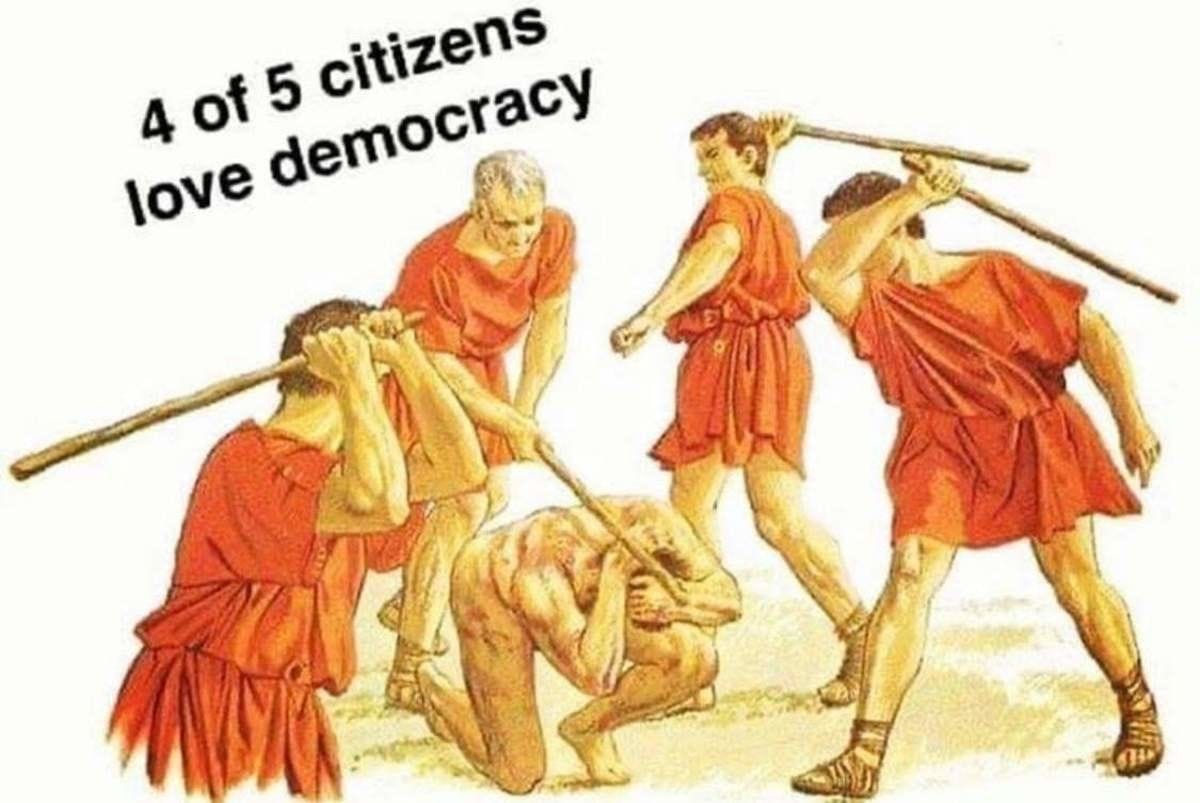
Republicans of late have been big on stating that the US is a republic, NOT a democracy, and this meme tries to give the viewer the impression that democracies intrinsically have no rules other than “majority rules”. Of course, almost any adult citizen in the US knows that the US constitution’s first ten amendments, known as the bill of rights, prevent the majority from voting to beat to death a person for sole the reason that they don’t like him or her.
I don’t like to see these kind of memes go unclarified, so I usually will say something like “Democracies can contain protections for people just as easily as republics”. I then would differentiate a democracy from a republic according to my very brief instruction by a junior high history teacher, oh so many years ago. He said that the defining feature of a democracy is direct public voting on EVERYTHING (or close to everything). Meanwhile, republics involve representatives, people that are selected to do most of the crafting of legislation and voting. He probably also noted that ancient Athens, Greece was the prototypical democracy (and to date, just about the only functioning example of a pure democracy), and that the ancient Roman republic was the prototypical republic.
Some recent comments in yesterdays “Coffee and COVID” substack brought up this meme and the apparently not-rare belief that democracy equals mob rule. I started to look up the definition of democracy, then pulled up the online Encyclopedia Britannica article on it. Rather than spend a lot of time discussing this with ONE person, who will almost certainly not be swayed, I thought I would make a substack, and divert time from what I would otherwise be doing. (See note at bottom if you want to know what I would be doing).
Definition of democracy (American Heritage Dictionary)
So I first looked up the definition of democracy. As is often the case, there are several definitions. Here’s the first one I came across in a web search:
noun
Government by the people, exercised either directly or through elected representatives.
A political or social unit that has such a government.
The common people, considered as the primary source of political power.
Majority rule.
The principles of social equality and respect for the individual within a community.
Government by the people; a form of government in which the supreme power is retained and directly exercised by the people.
Government by popular representation; a form of government in which the supreme power is retained by the people, but is indirectly exercised through a system of representation and delegated authority periodically renewed; a constitutional representative government; a republic.
Similar: republicCollectively, the people, regarded as the source of government.
The principles and policy of the Democratic party, so called.
OK, I was mistaken when I assumed that “democracy” implies direct voting. Definition 1 says the voting can be either direct or through representatives, while definition 7, oddly enough, seems to be that of a republic.
Definition 5 includes “respect for the individual within the community”. That would seem to contradict the idea that a majority could simply vote to beat a person or despised minority to death, as the meme implies. Obviously, reality often falls far short of ideals. Ancient Greece, ancient Rome and not-so-ancient United States all practiced slavery. And that’s not even getting into the many cases where democracies and republics are so riddled with corruption that they are functionally oligarchies or dictatorships.
Here’s the same dictionary’s definition of republic:
Definition of republic (American Heritage Dictionary)
noun
A political order whose head of state is not a monarch and in modern times is usually a president.
A nation that has such a political order.
A political order in which the supreme power lies in a body of citizens who are entitled to vote for officers and representatives responsible to them.
Today definitions of democracy and republic overlap so much it’s kind of a distinction without a difference at this point. If you do a web search like “US democracy or republic” you can see a lot of articles that have titles that say it is both. But generally conservative leaning websites will be more likely to say it’s a republic, and liberal leaning websites will say it’s a democracy.
Here’s one article I found (I have not searched to see what the reputation of this site is, but this article at least seems pretty evenhanded):
https://www.thisnation.com/government/learn/united-states-democracy-or-republic/
Quote: “It is worth noting that the definition of democracy has evolved over time. During the debate over the original United States Constitution most dictionaries used the Athenian definition of democracy, which did not include representative governance at all. All matters were directly decided by mass voting.”
Benjamin Franklin famously declared the new US government was republic when asked what form it was.
There you have it.
What I would otherwise be doing is making myself freak out even more over the size of the US debt and deficits, and trying to estimate how fast the inflation rate will increase. It HAS already started to go parabolic, and the US government has almost certainly been “funding” the deficit by electronically printing money for some time now - much more that it’s admitted. We have now officially passed the point where the publicly held debt is more than 100% of GDP, and the deficit is about 7% of GDP. Nobody is seriously talking about cutting spending or increasing taxes except RFK Jr, who has no chance of winning. And even his platform of cutting military spending by 50% 1) has no chance politically and 2) wouldn’t be nearly enough. I made spreadsheets calculating estimated debt, deficits and such no less than 30 years ago based on CBO estimates, and while I put those aside for awhile, I’m back it.
Great article and something I thought about myself. I grew up in Switzerland, which is a direct Democracy and I would say, it actually works a lot better than the US. It's in a direct Democracy, where citizens get to vote on almost all issues, whereas in a representative Democracy, they don't. I was taught in school that a country can be both a Republic and a Democracy. E.g. DDR: "Deutsche Demokratische Republic", former East Germany.
By the way, yeah the debt is concerning, but the unfunded liabilities at 215 trillion USD is worse. Not sure if you have ever looked into Bitcoin. It was actually another fellow actuary who got me into Bitcoin back in 2017. My boss recently asked me to do a presentation on the topic at work. If you want, I can send you a copy. I'm just brining this up because BTC is hard money and, imo, is the best solution to the current financial chaos and the out of control debt.